Foez Dewan
Principal
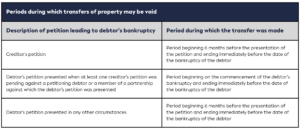
Generally, if a person becomes bankrupt on either a creditor’s petition or a debtor’s petition, a transfer of property by the bankrupt that constitutes a preference is voidable if it occurred within the six months immediately preceding the presentation of the petition.
However, if a person presents a debtor’s petition while a creditor’s petition is already on foot, the period during which a transfer of property may be void commences upon the commencement of the debtor’s bankruptcy.
Set out in the table below are the periods during which transfers of property may be void under different scenarios pursuant to s 122 of the Bankruptcy Act 1966 (Cth) (the Act).
As to the commencement date of the debtor’s bankruptcy referred to in item 2 above, set out below are different scenarios under s 115 of the Act:
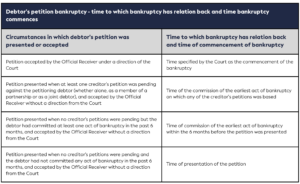
As is apparent from item 2 above, the presentation of a debtor’s petition while a creditor’s petition is on foot may have the effect of shortening the relation‑back period, as was demonstrated in Chu v Darmali [2025] FCA 1626.
McCabes acted for the judgment creditor, Ms Chu, arising from a judgment and costs order obtained against the judgment debtor, Mr Darmali in Federal Court proceedings. The proceedings concerned Ms Chu’s application to annul Mr Darmali’s debtor’s petition and to obtain a sequestration order in respect of his estate. A key issue in this case was that the presentation of the debtor’s petition had the effect of shortening the relation‑back period under s 122 of the Act and implications arising therefrom.
A short chronology of Chu v Darmali is as follows:
Pursuant to s 115 of the Act, the commencement of Mr Darmali’s bankruptcy upon presentation of his debtor’s petition is taken to be the date of the earliest act of bankruptcy relied upon by any petition, namely 17 October 2024 when he failed to comply with a bankruptcy notice. By operation of s 122 of the Act, the relation‑back period accordingly commenced on that date, rather than 6 months earlier on 18 April 2024 (which would have been the date if he was made bankrupt relying on the creditor’s petition filed against him). The payment made on 20 August 2024 by Mr Darmali to his mother, therefore, fell outside the relation‑back period. The payment would have been otherwise voidable as an unfair preference payment.
Ms Chu sought orders to annul the debtor’s petition presented by Mr Darmali, so as to preserve the earlier relation‑back date.
Ms Chu submitted to the Court that:
Although Mr Darmali contended that the presentation of his debtor’s petition was motivated by a genuine belief that he was insolvent and unable to pay his debts, Justice Needham found that his conduct was inconsistent with that asserted belief. In particular, her Honour observed the following:
In those circumstances, Justice Needham held that the debtor’s petition “ought not to have been presented” and that its presentation constituted an abuse of process. Accordingly, her Honour annulled the debtor’s petition presented by Mr Darmali and made a sequestration order based on Ms Chu’s creditor’s petition, so as to ensure that the relation back date could be the earlier date of 18 April 2024.
Her Honour further ordered that Ms Chu’s costs of the proceedings, together with the costs of the interim application, be taxed and paid out of the property of the bankrupt with the priority accorded to the costs of a successful petitioning creditor, pursuant to s 109(1)(a) of the Act.
Leaving aside the legal issues discussed above, her Honour found that Mr Darmali in his submissions relied on a number of cases that were not authority for the propositions for which they were cited. Mr Darmali subsequently admitted that he had used a generative artificial intelligence tool to generate his submissions, which explained the inappropriate and inaccurate references.
This serves as a reminder of the significant risks associated with the uncritical use of generative artificial intelligence and highlights the need for careful and independent verification of authorities.
Removing and replacing a liquidator is a significant step in the course of a company’s winding up. Although liquidators are charged with important public‑interest obligations and performance standards, there are circumstances in which their conduct, independence, or efficiency may fall short.

A landmark decision in the UK High Court handed down earlier this year found serious allegations of ongoing fraud and forgery by the defendant: COPA v Wright [2024] EWHC 1198 (Ch). A follow up judgment, COPA v Wright [2024] EWHC 1809 (Ch), highlights the potential ramifications for individuals who knowingly mislead and deceive the Court in order to advance their position in legal proceedings.