Michael Bracken
Principal
If you carry on a financial services business in Australia, you will need to hold an AFS licence, unless relief is granted by ASIC or a regulatory exemption applies.
However, a Foreign Financial Services Provider (FFSP) engaging with relevant Australian investors, may be eligible to apply for a modified form of an Australian financial services licence (AFSL), known as a ‘foreign AFS licence’ or otherwise they may rely on various exemptions from the requirement to hold a foreign AFSL.
A range of FFSPs have, to date, commonly relied on a series of exemptions via Class Order and other relief and operated in Australia in a limited way without a requirement to hold an AFSL.
Generally, where an FFSP is authorised to provide financial services under a ‘sufficiently equivalent’ overseas regulatory regime (Regulated FFSP) to wholesale clients, it may be eligible to apply for a ‘foreign AFS licence’ which permits it to provide substantially similar financial services but exempts it from certain provisions in Ch 7 of the Corporations Act which might otherwise apply under a standard AFSL.
The rationale for foreign AFS licensee relief is that a Regulated FFSP is subject to equivalent overseas regulatory requirements that would achieve similar regulatory outcomes to the exempted provisions and the FFSP is expected to be complying with relevant obligations imposed by the foreign regime for the provision of those relevant financial services.
The foreign AFS licensing regime is a modified AFS licensing regime for Regulated FFSPs that wish to provide those financial services to wholesale clients in Australia.
The application process for a foreign AFS licence is streamlined in recognition of the overseas regulatory status as a Regulated FFSP.
To be eligible to apply for a foreign AFS licence must:
A streamlined application process applies to applications for a foreign AFS licence. See RG 176 FFSPs.
Significantly, on 8 April 2026, the Treasury Laws Amendment (Genetic Testing Protections in Life Insurance and Other Measures) Bill 2025 received Royal Assent (FFSP Legislation) and which amends the Corporations Act to include:
An FFSP may rely on various exemptions from the requirement to hold a foreign AFSL.
Currently, there are two main forms of relief available to a FFSP that is carrying on a financial services business in Australia:
As discussed above, the new FFSP Legislation introduces three new FFSP exemptions:
There is also a narrower form of funds management relief applying to offshore fund financial products or financial products under a portfolio management mandate to eligible Australian users.
The New Exemption Regime is scheduled to commence on 1 April 2027.
This will bring an end to the operation of the Existing Exemption Framework which continues until March 31, 2027 (subject to any extension) and will be replaced by the New Exemption Regime.
The Table below, sets out a summary of the application and relevant conditions under each new exemption.
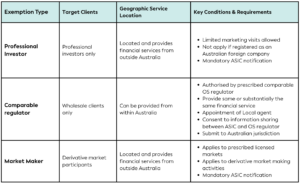
There are also general conditions with which a FFSP must comply, to rely on the relief under the New Exemption Regime which includes a mandatory ASIC notification requirement that the FFSP intends to rely on the relief, and to provide information required by ASIC within a 15-business-day window from the day on which the financial service is first provided.
FFSPs providing or intending to provide financial services in Australia or intending to commence engaging with relevant Australian investors should consider the impact of the changes under the new FFSP Legislation well before the deadline of 31 March 2027.
For those FFSP’s currently relying on the Existing Exemption Framework, they will be able to continue to rely on the relief during the transitional period until 31 March 2027, unless otherwise extended.
However, current Exempt FFSP’s will need to decide upon the specific exemption under the New Exemption Regime upon which they intend to rely or alternatively if they do not meet the new conditions then consider applying for a standard or foreign AFSL.
FFSPs who are or were not eligible for the current licensing relief under the Existing Exemption Framework may also consider if, going forward, they might be eligible for licensing relief under the New Exemption Regime and to notify ASIC of their intention.
New FFSP entrants wishing to engage with Australian investors will need to assess if their operations and distribution structure is captured by the Australian financial services licensing regime having regard to their home jurisdiction, target Australian clients, offshore and onshore distribution model.
Those FFSP’s will need to:
Early planning is critical as the new FFSP licensing regime requires ASIC notification and preparation of supporting documents before offering new or ongoing financial services under the new regulatory framework. In any event, FFSPs relying on the licensing relief should familiarise themselves with the specific qualifying conditions and ongoing obligations to ensure compliance.
FFSP’s considering their operations in Australia and potential licensing or exemption pathways should contact McCabes Financial Services & Financial Institutions Team for further assistance.
The General Insurance Code of Practice (Code) is undergoing reform to expand its scope and to include proposed changes that strengthen consumer protections, accountability and enforceability of the Code.

In March 2026, Treasury released an exposure draft of the Treasury Laws Amendment Bill 2026: Payments System Modernisation, which is new legislation that overhauls the regulatory framework for payment service providers in Australia.
