
Michael Bracken
Principal
In March 2026, Treasury released an exposure draft of the Treasury Laws Amendment Bill 2026: Payments System Modernisation, which is new legislation that overhauls the regulatory framework for payment service providers in Australia.
The Bill reflects a change of regulatory focus under the existing regulatory regime, which will now focus on the functions and activities performed by payment service providers (PSPs) rather than responding to specific technologies under the current regime.
It updates the regulatory architecture to capture new types of financial products and services, and therefore some currently unregulated payment products and new payment technologies and business models are likely to be caught under the new licensing regime.
The scope of the reform is broad-ranging and captures payment systems as well as payment services and stored value facilities.
This article describes the underlying regulatory policy shift and how the new classification of payment services will impact the financial services market.
The current regulation of payment services under the financial services regime is generally captured under the concept of a NCP facility, which is:
” a facility through which, or through the acquisition of which, a person makes a non-cash payment’.
Providers of financial services – including issuance, other forms of dealing services, and the provision of financial product advice – in relation to NCP facilities are required to hold an AFS licence.
The NCP facility product type and licence authorisation does not distinguish between different types of activities or functions that are performed in relation to payments. In the regulator’s view, the range of activities performed by different PSPs in modern payment chains is not adequately regulated based on different levels of risks, and the regulatory framework does not effectively account for these differences.
The reforms will introduce the following changes:
1. replace the existing concept of ‘makes a non-cash payment’ under the general definition of financial product and non-cash payment facility, which forms the basis of the current AFS licensing framework that regulates payment services
2. introduce new specific definitions for different types of:
For example, the reforms recognise the distinction between various financial services such as payment initiation, payment facilitation and payment technology and enablement services and includes new financial products by defining tokenised SVFs as a regulated means of storing and transferring value.
It will significantly impact the payment services industry by, among other things, extending the scope of regulated activities or functions to capture service providers that play a key role in the payment chain but are not currently covered by the definition of NCP facility.
Further, it will distinguish between and recognise that some activities are more appropriately regulated as financial services rather than financial products, and it will also provide additional clarity on the entities and types of products and services intended to be regulated under the new framework.
The expanded AFS licensing framework will cover the provision of payment services and payment product-related services by adding:
The introduction of payment services as a new type of financial service means that some existing NCP facilities will cease to be financial products and instead will be regulated as financial services.
The AFS licensing framework will also cover conduct relating to creating or redeeming a digital token that is attached to a right to an amount standing to the credit of a tokenised SVF.
By way of guidance, the regulatory split between payment arrangements which will be regulated as a financial product or otherwise as a financial service is summarised in the table below.
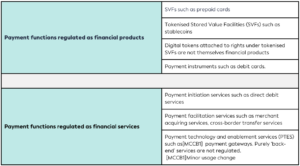
To understand how the scope of payment business models, technologies and activities in the payment chain will be more broadly captured under the new regime, part of the answer is due to the introduction of a significant number of new key terms in the Corporations Act which reflect a more detailed articulation of the steps, functions, activities and participants in the payment chain.
For example, each of the following defined terms may potentially apply to a payment arrangement:
Also under the Bill, the Purchased Payment Facility (PPF) regime will be repealed and replaced by AFS licensing requirements for SVF providers.
Providers of payment services and payment product-related services will be required to hold an AFS licence and comply with the general obligations that apply to other AFS licensees.
Existing PSPs holding an AFSL with authorisations relating to an NCP facility or product will also need to reconsider what authorisations they will need under the new regime as the NCP definition will disappear.
In transitioning to the new payments regime, a PSP will need to understand the scope and application of these new terms to their payment services configuration and technologies. They will need to manage their regulatory compliance risk and ensure that their AFS Licence authorisations properly and adequately picks up those activities and/or functions.
In practice, this is likely to involve conducting a regulatory audit or regulatory risk analysis of the specific payment functions and activities involved in their payment services configuration and technologies, as well as their role in the payments chain.
The amendments under the Bill will commence 12 months after Royal Assent. The passage of the Bill through Parliament is currently undetermined.
The proposed transitional compliance arrangements will vary depending on whether an entity already holds an AFS licence with payment-related authorisations.
PSPs without relevant authorisations have 6 months after commencement to apply.
PSPs with relevant authorisations have 1 month after commencement to apply for a variation.
For guidance on planning for the impact of the new payment services licensing regime and its requirements, please contact our Financial Services & Financial Institutions Group.
We are proud to announce the appointment of Michael Bracken as Principal, to lead a new Financial Services and Financial Institutions practice group within our Commercial division.