Employment

Key Employment Law Changes Taking Effect 1 July 2026

1 July, 2026

A number of significant employment law reforms will take effect on 1 July 2026. These changes will impact the following areas:

  1. the national minimum wage and award rates.
  2. unfair dismissal thresholds and compensation.
  3. Victoria’s regulation of non-disclosure agreements in sexual harassment matters.
  4. expanded Government-funded parental leave entitlements.
  5. the introduction of payday superannuation.
  6. substantial reforms to workers compensation scheme in New South Wales.

This article outlines these key changes.
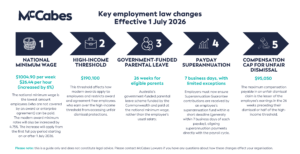
1. Increases to minimum wage and award rates


From 1 July 2026, the following changes will take effect:

  • a 6% increase in the national minimum wage. The new weekly minimum wage will be $1004.90 a week or $26.44 an hour.
  • a 4.75% increase in all award rates.

2. Unfair Dismissal Changes from 1 July: Higher Income Thresholds and Compensation Caps


From 1 July 2026:

  • the high-income threshold under the Fair Work Act 2009 (Fair Work Act) will increase from $183,100 to $190,100. This threshold is relevant to employees making unfair dismissal applications and contractors challenging unfair deactivations and contractual terms
  • the maximum compensation available in unfair dismissal and unfair deactivation claims will also rise from $91,550 to $95,050 (reflecting the statutory cap of one-half of the high-income threshold).
  • in addition, the filing fee for applications made under the Fair Work Act respect of unfair dismissal, general protections and anti-bullying/sexual harassment applications will increase from $89.70 to $92.70. However, there is no fee for sexual harassment dispute applications.

3. Victoria’s restrictions on NDAs to come into effect


The Restricting Non-Disclosure Agreements (Sexual Harassment at Work) Act 2025 (Vic) (the Act) will come into effect on 1 July 2026. The Act regulates the use of Non-Disclosure Agreements (NDAs) in sexual harassment cases

The key features of the Act include:

  • prohibition on NDAs unless requested by the complainant;
  • ban on pressure or influence being applied to a worker to enter into an NDA;
  • strict preconditions where if a complainant has requested a workplace NDA, they are provided with a mandatory information statement and a 21-day review period;
  • exceptions for workers who have entered into NDAs allowing them to speak to specified parties (e.g. Victoria police, medical and legal professionals); and
  • right to terminate NDAs by giving 12 months of notice to the other party.

4. Expansion of Government-Funded Parental Leave


Significant changes to government‑funded parental leave arrangements were made at the end of last year and will take effect from 1 July 2026. From that date:

  • Parental Leave Pay (PPL) will increase from 24 to 26 weeks (130 days, based on a standard five-day week) for eligible parents.
  • PPL will continue to be paid at the national minimum wage and can be shared between parents. However, at least 4 weeks (up from 3 weeks) of the total 26 weeks must now be used by the second parent.
  • the ATO will pay a superannuation contribution of 12% on PPL payments directly to an employee’s superannuation fund. Contributions will be paid after the end of the financial year an employee got PPL pay.

5. Payday Superannuation


The reforms under the Treasury Laws Amendment (Payday Superannuation) Bill 2025 and the Superannuation Guarantee Charge Amendment Bill 2025 will come into effect from 1 July 2026.

Employers will now generally be required to pay Superannuation Guarantee (SG) contributions at the same time as wages and salaries are paid (rather than quarterly).


Key Changes Employers Need to Know

1. New concept of “qualifying earnings”: The existing concept of “ordinary time earnings” has been expanded and replaced with a new term, “qualifying earnings”. Qualifying earnings will determine the amount on which SG contributions are calculated.

2. SG contributions due within 7 business days: After qualifying earnings are paid, employers will typically have 7 business days to ensure the corresponding SG contributions are received by the employee’s superannuation fund. This marks a move away from the current quarterly payment model.

3. Limited exceptions to the 7day rule: In certain circumstances, employers will have up to 20 business days to make SG contributions, including where:

  • the payment relates to the first SG contribution for a new employee;
  • exceptional circumstances apply (such as natural disasters or widespread ICT outages); or
  • the earnings are paid out of cycle (such as commissions, bonuses, payments made in advance, or back pay).

4. SG charge: If SG contributions are paid late (or not paid at all), employers may be liable for the SG charge. The SG charge will be the sum of:

  • total individual final SG shortfalls;
  • total of the employer’s individual notional earnings components;
  • employer’s administrative uplift amount; and
  • total of the employer’s choice loadings.

5. Other consequences: Late payment of SG contributions may also breach the Fair Work Act or an applicable award or enterprise agreement.


Contributors

Angus Dowey, Lawyer


Recent Insights

View all
Employment

Victoria Moves to Enshrine the Right to Work from Home

Victorian Premier Jacinta Allan has introduced the Equal Opportunity Amendment (Work from Home) Bill 2026, which would create a statutory right for employees to work from home at least two days per week, where it is reasonable to do so.

Published by Tim McDonald
19 June, 2026
Employment

Termination of Employment: Key Lessons from Recent Fair Work Commission Decisions

Recent decisions of the Fair Work Commission (Commission) offer timely and practical guidance for employers navigating one of the most sensitive aspects of the employment relationship — termination.

Published by Tim McDonald
15 June, 2026